
- LOWER EXTERMITY PROSTHESIS
- Prosthesis is an artificial device that replaces a missing body part, which may be lost through trauma, disease, or a condition present at birth (congenital disorder)to make a part of the body work better.
- Prostheses are most commonly prescribed for lower limb amputation. Amputation is defined as the removal of the limb through a part of the bone .The lower limb amputation is the most common amputation nearly85 percent of all amputations. The function of lower limb is weight bearing and locomotion. Lower limb prostheses are used to provide an individual who has an amputated limb with the opportunity to perform functional tasks, particularly ambulation (walking) which may not be possible without the limb.
- At rising steps we are providing high technology of prosthesis.In prosthesis there are a different types of socket,foot knee joints and hip joints .we choose the prosthetic components after doing assessment, consultation and diagnosis.
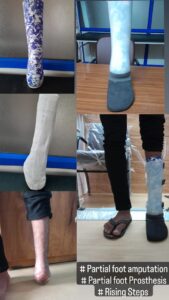
- PARTIAL FOOT PROSTHESIS
- Partial foot amputation prostheses can be divided into two categories
- High-profile designs that extend onto the tibia up
- Low-profile devices that terminate inferior to the malleolus.
- It seems that many individuals with partial foot amputations prefer to use the low-profile prostheses, specifically, flexible and semi flexible designs.

2. BELOW KNEE OR TRANS –TIBIAL PROSTHESIS
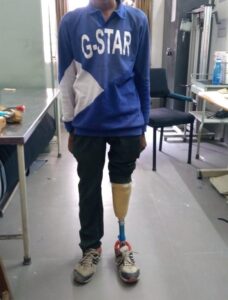
- A below knee (BK) or transtibial (TT) prosthesis is custom made for a person who has had a BK or TT amputation. The prosthesis consists of a custom-made socket, liner, pylon, and foot. Sometimes the prosthesis may consist of a sleeve or other harness, depending on the suspension system used for that patient.
3. ABOVE KNEE OR TRANS FEMORAL PROSTHESIS
- An above knee (AK) or transfemoral (TF) prosthesis is custom made for a person who has had AK or TF amputation. The prosthesis consists of a custom-made socket, liner, knee, pylon, and foot. Sometimes the prosthesis may consist of a sleeve or other harness, depending on the suspension system used for that patient.


4. HIP DISARTICULATION PROSTHESIS
- Hip disarticulation prosthesis is custom made for a person who has removal of the lower limb from the hip joint. The prosthesis consists of a custom-made socket, liner, hip joint knee joint, pylon, and foot. Sometimes the prosthesis may consist of a sleeve or other harness, depending on the suspension system used for that patient.

UPPER EXTERMITY PROSTHESIS
- Upper Limb Prostheses Includes Terminal Device (TD), Interposing Joints, Socket, Suspension, And Control System.
Typically, There Are Three General Classes of Upper Extremity Prostheses,
- Cosmetic
- Body-Powered
- Myoelectric.
- There Are Also Hybrid Type Prostheses Available.
1) TRANS RADIAL PROSTHESIS
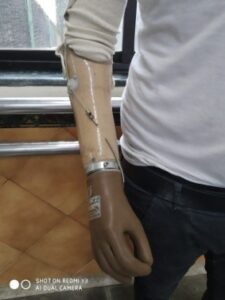
- A Trans radial or below elbow prosthesis is custom made for a person who has had a Trans radial or below elbow amputation. The prosthesis consists of a Terminal device, wrist unit, socket, and harness system.
- There are 3 basic types of transracial prostheses:
- A cosmetic prosthesis is for appearance only and does not move.
- A conventional (or body-powered) prosthesis is connected to the body by a series of cables. By moving your body in different ways, it is possible to move the prosthesis and even open and close the artificial hand.
- A myoelectric prosthesis is the newest and most advanced form of transradial prosthesis. It connects an electronic hand to the muscles in your arm. As the muscles contract, electrodes send a signal to the artificial limb, causing it to move in much the same way as your real hand.

2) TRANS HUMERAL OR ABOVE ELBOW PROSTHESIS
- A Trans humeral or above elbow prosthesis is custom made for a person who has had a Trans humeral or above elbow amputation. The prosthesis consists of a Terminal device, elbow unit, wrist unit, socket and harness system.
